CopterSonde SWX
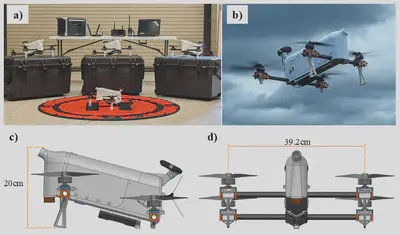
Built for Severe Weather Profiling
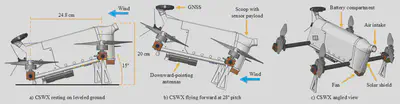
Tried and Tested Under Harsh Conditions
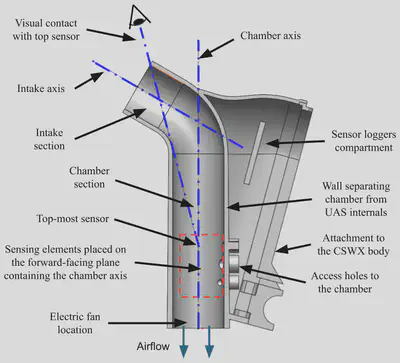
Precision Measurements When Conditions Get Extreme
The CSWX was developed to support high-resolution planetary boundary layer profiling for research and future assimilation into prediction systems—especially under sustained high winds and precipitation that ground lower-thrust platforms. Development and evaluation are described in Segales et al. (2026), Atmospheric Measurement Techniques. Dual battery modes allow operators to prioritize wind penetration (6S LiPo) or altitude/endurance (6S LiIon) depending on the mission.
Our goal with the CSWX is a resilient, high-fidelity WxUAS that advances the CopterSonde from research prototype toward operational severe-weather observing.
Sample Performance: Nocturnal Low-Level Jet
In colocated nocturnal LLJ soundings with the CS3D, the CSWX sustained winds approaching ~24 m s⁻¹ up to about 520 m, while the CS3D reached its ~20 m s⁻¹ limit near 275 m and automatically returned to launch. Thrust-margin analysis projects a safe mean-wind tolerance near 29.5 m s⁻¹ (~818 m in that profile) with roughly 35% battery energy remaining for return—nearly a 200% increase in reachable altitude relative to CS3D under the same wind conditions.
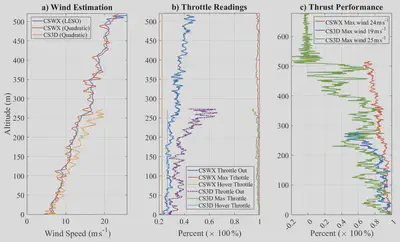
Key Features of the CopterSonde-SWX
Custom ArduPilot firmware on a CubePilot CubeOrange extends CS3D capabilities for severe-weather operations. Highlights include:
- High-thrust tilted-body airframe: Fixed ~15° fuselage angle with carbon-fiber plates/arms and a polycarbonate shell reduces frontal drag while preserving stability; 3110-size 900 KV motors, 80 A ESCs, and 10×4.5 in propellers produce ~3.8 kgf thrust per rotor.
- Dual operational battery modes: 6000 mAh 6S LiPo (130 Wh) for high-wind penetration, or 9000 mAh 6S LiIon (194 Wh) for ~30% longer endurance and potentially >2000 m AGL in lighter winds.
- Environment-aware failsafes: Wind-limit monitoring and battery-aware logic can trigger Return-To-Launch before thrust or energy margins are exhausted.
- Wind vane flight mode (WVFM): Orients the scoop into the wind so sensors sample undisturbed inflow.
- Shielded aspirated scoop: Three iMet-XF bead thermistors and three IST HYT-271 humidity sensors with a ducted fan (~12 m s⁻¹ aspiration) for redundant, solar-shielded thermodynamics.
- LESO 3D wind retrieval: Full three-component winds from platform dynamics—no dedicated anemometer—validated against Doppler lidar and radiosondes.
- Long-range command link: HereLink 2.4 GHz radio provides a robust GCS link out to ~20 km, with tailored visualization of telemetry and sensor streams.
- Rain-resilient packaging: Near-sealed airframe with strategic vents supports wet-weather profiling alongside high-wind operations.
Platform Technical Specifications
Specifications below follow Table 1 of Segales et al. (2026) for the high-performance (LiPo) configuration from 65+ flight tests. Values outside parentheses are maximums observed in testing; values in parentheses are analytically derived upper bounds under idealized conditions (not reached in testing due to safety margins).
| AIRFRAME & SYSTEMS | PROPULSION (per rotor) | ||
|---|---|---|---|
| Body | Carbon-fiber plates & arms; aluminum standoffs; ~15° tilted fuselage | Brushless motor | 3110-size, 900 KV |
| Shell | 3D-printed polycarbonate | Max. thrust | ~3.8 kgf @ 14 000 rpm |
| Flight controller | CubePilot CubeOrange (custom ArduPilot) | Propellers | 10 × 4.5 in |
| All-up weight | 2.85 kg | ESC continuous | 80 A |
| Payload weight | 300–450 g | Motor power | 610 (2100) W |
| Communications | Cont. / peak current (system) | 65 (140) A / 110 (264) A | |
| Radio | HereLink 2.4 GHz | Input voltage | 26 V (6S) |
| Link range | ~20 km | Motor temperature | 65 (105) °C |
| POWER | |||
| High-wind mode | 6S LiPo 6000 mAh (130 Wh) | Endurance mode | 6S LiIon 9000 mAh (194 Wh) |
| Hover time (to 10% batt.) | 15.6 min |
| Meteorological Specifications | Flight Envelope (LiPo mode) | ||
|---|---|---|---|
| Thermodynamic | Mean wind tolerance | 25 (31.8) m s⁻¹ | |
| Primary sensors | 3× iMet-XF (T); 3× HYT-271 (RH) | Gust tolerance | 28 (35.4) m s⁻¹ |
| Inter-sensor T uniformity | within ±0.2 °C | Forward top speed | 35.4 m s⁻¹ |
| Aspiration | ducted fan ~12 m s⁻¹ | Climb / descent rate | 5 (12.5) / 7 (10) m s⁻¹ |
| Temperature range | −20 to 45 °C | Altitude AGL | 1500 (3000) m |
| Relative humidity | 0–100% | Min. air density | 0.95 (0.85) kg m⁻³ |
| Kinematic | Mechanical vibration | 30 m s⁻² | |
| Method | LESO (no anemometer) + WVFM | Observed high-wind case | ~24 m s⁻¹ @ ~520 m |
| Wind RMSE (vs references) | 0.49 m s⁻¹ vertical; 1.03 m s⁻¹ horizontal | Projected safe wind limit | ~29.5 m s⁻¹ |
| Primary variables | T, RH, P; 3D wind | Absolute wind limit (Thₚ≈0) | ~33.5 m s⁻¹ |
| For more information regarding the CS or custom built solutions contact us! |
Full technical description, validation, and figures: Segales, A. R., et al. (2026): The CopterSonde-SWX: a weather-sensing UAS for severe weather and high-wind planetary boundary layer profiling, Atmos. Meas. Tech., 19, 3667–3686.